
Heterodox Global Advisory
Heterodox Global Advisory
Trade and development policy that goes beyond
the conventional wisdom
Evidence based trade strategy, policy innovation, and economic development advisory for governments, multilateral institutions, and CEOs.
Navigating geopolitical risk, trade strategy, supply chain security, and investment in developing markets.
Worldly wisdom teaches that it is better for reputation to fail conventionally than to succeed unconventionally.
John Maynard Keynes
Most trade and development advice follows the opposite instinct: safer to repeat what every other firm in the room is already saying than to follow the evidence somewhere less comfortable.
Heterodox economics is the established academic term for schools of thought that challenge mainstream orthodoxy when the evidence demands it, not contrarian for its own sake, but rigorous enough to follow the data past conventional wisdom. That discipline is what this firm is named for.
Corporates and governments alike have operated on inherited assumptions: that trade compliance is a cost rather than an advantage, that market entry follows a standard playbook, that government and private capital work in separate worlds, that aid precedes trade. The evidence points elsewhere.
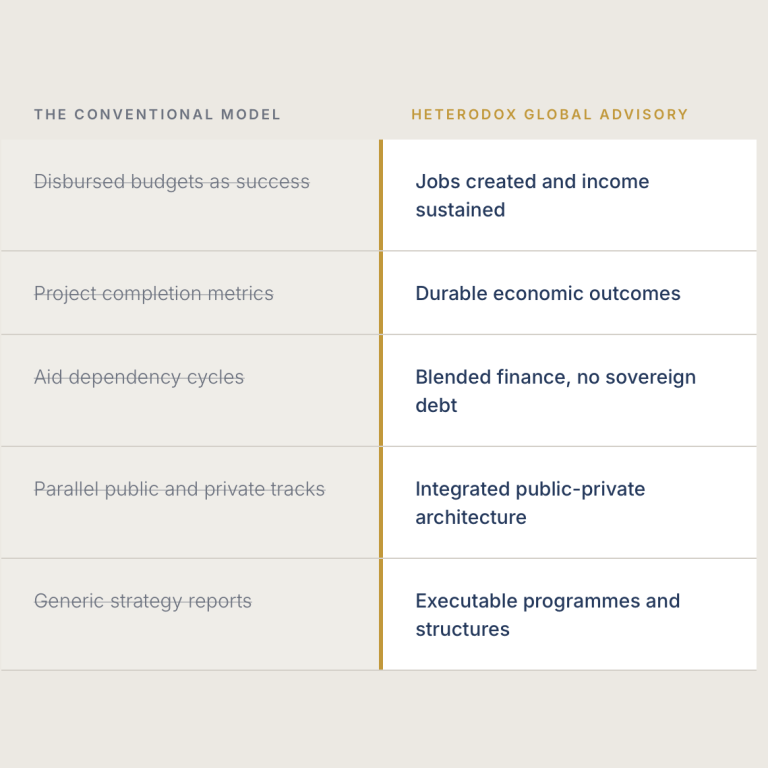
The dominant model measures disbursed budgets and completed projects. We measure outcomes, not outputs: jobs created, income sustained, and revenue; corporate or public, that outlasts the programme cycle or the deal cycle. That shift is the paradigm at the heart of everything we do.
We don't borrow the industry's "impact" vocabulary. We build the architecture, governance, financing and execution frameworks including, where the evidence calls for it, entirely new models for how capital, policy and delivery meet on the ground and we are judged by what actually changes.

Strategy and Policy That Delivers Results.
What we do
Four practice areas.
One integrated approach.
01 — TRADE STRATEGY
Grounded in primary evidence rather than perceived wisdom. We advise multinational corporates on supply chain strategy, trade compliance and market entry into complex jurisdictions, and governments and institutions on trade strategy that moves from policy design to executable frameworks, including regulatory reform, trade facilitation, and market access architecture.
The same evidence base runs through both, because we have sat on both sides of the table: in customs enforcement and corporate leadership, in financial regulation and compliance, and in board level communications, so the advice we give one side accounts for how the other will actually respond.
02 — GEOPOLITICS & SUPPLY CHAIN
Helping companies and governments identify vulnerabilities, secure critical supply routes, and build resilient procurement and logistics strategies in an era of fragmentation, sanctions, and structural realignment of global trade flows.
For corporates, that means sanctions and export control compliance, exposure mapping across supplier networks, and board level scenario planning for the disruptions that increasingly can't be diversified away.
For governments, it means securing the trade routes and supply relationships national resilience now depends on.
When disruption hits, a sanctions designation, a chokepoint closure, a sudden re-routing of trade, we work alongside the board or the ministry through the response itself, not just the pre-crisis plan.
03 — DEVELOPING MARKETS
Structuring blended finance pathways between development finance institutions, private capital, and government partners , without sovereign debt dependency.
Advisory on value addition programmes, agricultural sector investment, and DFI aligned investment architectures across Africa and beyond.
04 — PUBLIC-PRIVATE INTERFACE
Translating government strategy into commercially executable outcomes, and the reverse.
With a career spanning policy, strategy and operations in UK Government, HM Treasury, the IMF, and large multinationals, we operate fluently across both sides of the table, something that most advisories can only address from one direction.
In practice, that often means being the first call before a Board or Government commissions, a large consultancy: we scope what's actually needed, help select the right partner, and hold the work to account against outcomes once it lands, rather than adding a voice that only speaks one side's language.
THE DIFFERENCE
The advisory industry has made "impact" a marketing word. We treat it as a measurable commitment. The test is not what was spent or delivered it is what changed, and whether that change persists.
Wir benötigen Ihre Zustimmung zum Laden der Übersetzungen
Wir nutzen einen Drittanbieter-Service, um den Inhalt der Website zu übersetzen, der möglicherweise Daten über Ihre Aktivitäten sammelt. Bitte überprüfen Sie die Details in der Datenschutzerklärung und akzeptieren Sie den Dienst, um die Übersetzungen zu sehen.